How To Say I Love You In Italian
The lyricism and elegance of the Italian language has captivated foreigners for centuries. However, there are some guidelines to follow before uttering those mushy phrases.
The phrase “I love you” can be used in any context when speaking English. If you want to avoid embarrassment, however, you’ll need to learn two separate phrases in Italian.
The Italian expression for “I love you” varies depending on whether you are speaking to a romantic partner or a close friend or relative.
How To Say I Love You In Italian

Check out these articles for more Italian vocabularies:
- How To Say Hello In Italian
- Ways To Say Good Morning In Italian
- How To Say “Good Afternoon” In Italian
Degrees of affection are important in Italy
There are two primary ways to express romantic feelings in Italian, and they are not interchangeable. You can’t pick one and use it whenever you want to tell someone they’re special to you.
It may seem counterintuitive that you can’t simply toss around a single expression of the sentiment whenever the mood strikes, but that’s not the case. Italian “I love you” phrases aren’t as universally appetizing as cheese, which is delicious on both pasta and bread.
In this context, familiarity, affection, and social standing are all significant factors in how words are used.
One expression for ‘I love you” is something that only those closest to you will understand. The other phrase is only spoken between committed partners or for serious relationships, such as dating, marriage, or even living together. Don’t confuse the two!
The 2 Ways to Say “I Love You” in Italian
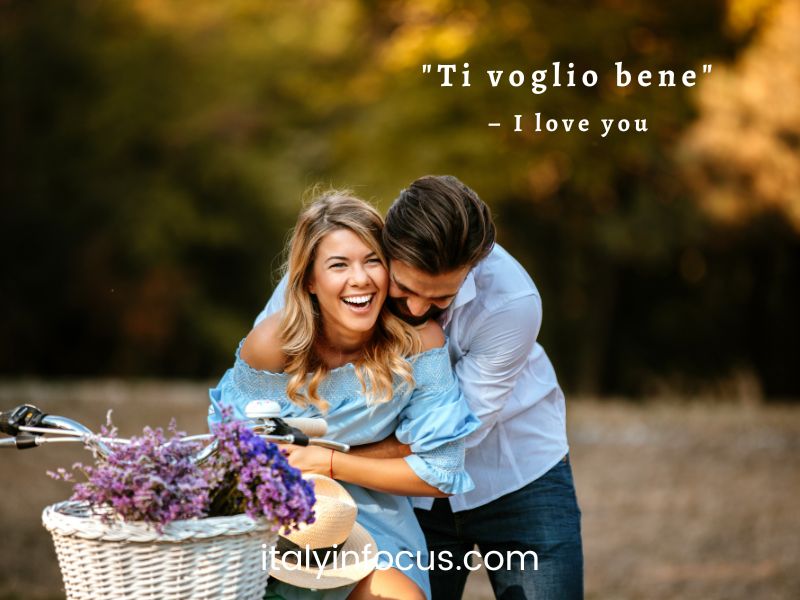
There are essentially two ways to say “I love you” in Italian, and they are as follows.
- Ti amo – I love you
- Ti voglio bene – I love you [literally translates to “I want you well”])
A declaration of love may seem uncomplicated because there are only two possible word combinations for this momentous and potentially life-changing occasion.
Saying “I love you” in Italian takes more than just a good accent and a sincere tone of voice. Familiarity and affection should guide your choice of phrase.
After comparing their contexts, picking the right love phrase will be a breeze.
Ti voglio bene – I love you
Ti voglio bene is the phrase to use when you want to show love to members of your family, friends, or other people with whom you do not have a committed relationship.
Ti amo – I love you

Check out these articles for more Italian vocabularies:
- Ways To Say Good Evening In Italian
- How To Say Thank You In Italian
- How To Say I Miss You In Italian
Ti amo is the most famous expression of love in the Italian language. It is used to express the kind of blissful and romantic love that many of us desire to experience in our lives.
It is something that married couples and engaged couples say to each other. There is no way that it could be for relatives or close friends.
Other Ways to Say “I love you” in Italian
Family/Friends
- Ti adoro – I adore you
Another phrase that can be used in many contexts. It’s brief and straightforward, coming right out of the phrase “ti amo.” The tone of this expression can be friendly or passionate.
Maybe you’re telling a close pal how much you appreciate them. To someone you have feelings for, perhaps.
One way or another, this is a catchall phrase that can be applied to a wide range of contexts.
- Ti amo papà/ti amo mamma – I love you daddy/I love you mommy
When compared to other languages, such as Spanish, the ways in which people express their love for their parents in English are much more casual. These are simple phrases, and they do not significantly alter the meaning of the root phrase “ti amo.” It is critical to make sure that your parents know how much you value and appreciate them.
Romantic Partner

Sei importante per me – You are important to me
Sei tutto per me – You are everything to me
Sono innamorato / innamorata di te – I’m in love with you
Ho bisogno di te – I need you
Significhi tutto per me – You mean everything to me
Voglio essere sempre con te – I always want to be with you
Sei l’uomo / la donna della mia vita – You’re the man/woman of my life
Hai conquistato il mio cuore: You’ve won my heart
Per te farei di tutto: I’d do anything for you
Con te voglio invecchiare: I want to grow old with you
Voglio passare il resto della mia vita con te. – I want to spend the rest of my life with you.
Sei l’unico/a per me. – You are the only one for me.
Sei il grande amore della mia vita. – You are the love of my life.
Ti voglio sempre al mio fianco. – I want you always by my side.